Monday, 13 August 2012

History & Development

Based on Thompson and Bordwell (2010), German film industries succeeded despite they were having a hard time in terms of economy and politic from the World War 1. The war has pushed the nation into a deep debt and a revolt even broken out before the war ends. Internal strife occurred. The Allies mistreated Germany and accused the country of being the main reason of conflicts between Great Britain and France. Germany’s territories were taken and number of soldiers was restricted. They are also being expected to pay for all the damages resulted from war in terms of money and goods. Besides that, Germany was to send high payments in gold and ship coal, steel, heavy equipment, food and other basic goods to the Allies.  Inflation too happened in the 1920s and the people was having a hard life. However, the inflation led to more exportation and less importation. This benefited the filmmakers . The government 1916 ban on foreign films, government support of local film and the demand from theatre encouraged more film-making. According to Mast and Kawin (2008), the government set up Universum Film Aktiengesellschaft (UFA) to merge and buy larger companies. By 1921, there were about 300 film production companies. (Thompson & Bordwell, 2010).

We can see that Expressionism gained significance between 1905 and 1918 during the revelation of the problematic conditions of Europe at the turn-of-the century. Between 1913 and 1929, many Expressionist artists had to flee persecution because they defied the silencing oppression of Nazism. Hitler felt that “modern art” was destruction of content and form, that there was an underlying conspiracy to destroy German identity. Expressionists tried to achieve spiritual cleansing by penetrating psychologically into human consciousness (Norris, 1996)  

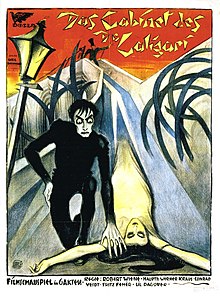
During the postwar era, there were a few major trends of genre and style and German Expressionist is one of them. In 1920, a film entitled The Cabinet of Dr. Caligari by Robert Wiene has caught the intention of the public and it was a success. It initiated the Expressionist movement. The film used distorted shapes, oblique camera angles, stylized settings and actors’ realistic performance.  It made its way to the cinema.
 
File:The Cabinet of Dr. Caligari poster.jpg
 The Cabinet of Dr. Caligari. (Robert Wiene, 1920)
Retrieved from http://en.wikipedia.org/wiki/The_Cabinet_of_Dr._Caligari

The goal of this movement is to express feelings directly and extremely and this too apply in literature and narrative techniques. The Expressionist movement emerged from 1920 to 1927. Kawin (2008) mentioned that in German films, subjective and objective perceptions become indefinite. The world might look distorted and unorganized because someone sees it that way or else it is burdened with wordless meaning. These films are mostly studio products because it is the only way to make sure that the lighting, the décor, the architectural shapes, the relationships of blacks, whites, and grays were perfect to be completely in controlled of the environment.
Traits in an Expressionist film are much focused on the mise-en-scene. The actors’ movements must blend in well with the settings. “Thus, not only did the setting function as almost a living component of the action, but the actor’s body become a visual element.” ( Thompson & Bordwell, 2010 ).  The actors move in a jerky or sinuous way. Exaggeration and distortion are not exception. Not only the setting has to be incongruous, the actors had to behave in an unnatural way and overdo their gestures.  Another major trait is the juxtaposition of similar shapes within a composition. Editing is simple and more to a slower pace. The camera mostly remained at eye-level angle or chest-level. Expressionist was mostly involved in horror or fantasy films. Other hallmarks of Expressionist are oblique camera angles, distorted angles, high contrast lighting between light and dark to create dramatic shadows, actors’ make-up and clothing. (Benyahia, Gaffney and White, 2006) There are some popular film-makers in this movement, such as Robert Wiene, Fritz Lang, and F.W. Murnau.  Nosferatu (1922), The Golem(1920), Metropolis(1927) are examples of Expressionist films.


Expressionist Filmmakers : Robert Wiene, Fritz Lang, F.W. Murnau ( from left to right )
Retrieved from en.wikipedia.org
Expressionist Films : Nosferatu (1922), The Golem(1920), Metropolis(1927) (from left to right)
Retrieved from en.wikipedia.org.


The success of films in German industry was of a short period. The reasons behind were the technology advancement of German studios, inflation ended and economy stabilization, filmmakers moved to Hollywood and trying to imitate and compete with Hollywood films.  The 2 major factors of the decline of Expressionist movement were the tremendous amount of budget of later films and the migration of Germany filmmakers to United States.


APA References : 

Benyahia, S. C., Gaffney, F., & White, J. (2006) A2 Film Studies: The Essential
              Introduction. United  Kingdom : Routledge Taylor & Francis Group.

Mast, G., & Kawin, B.F. (2008). A Short History of The Movies (10th ed.). United 
            States: Pearson Longman.

Norris, G. (1996). The artistic imagination suppressed. Retrieved from 
             http://www.vccaedu.org/inquiry/vcca-journal/norris2.html

Thompson, K. & Bordwell, D. (2010). Film History: An Introduction (3rd ed.). New 
            York, NY: McGraw Hill.

Friday, 10 August 2012

Characteristics Found In Films

The Last Laugh / Der Letzte Mann (Friedrich Wilhelm Murnau, 1924)


Murnau, F.W. (1924). The Last Laugh. [Poster]. Retrieved August 11, 2012 from https://blogger.googleusercontent.com/img/b/R29vZ2xl/AVvXsEh1363S8siRizxRJY5snnaPCWQltTpUaKi0GxJM6DNeHFi1cQ2tvKUnaObOTKc4IZcwREamP9gkioj9gd4S3oO3rR63C5I_YPBjJ8qi9lOi2SKyteQ3AbqqYB1LCbLwbQv6NXlXFk5jRfuh/s400/murnau09.jpg
Synopsis

This movie revolves around a hotel doorman who is demoted to a washroom attendant because he is no longer capable of the job. When the truth is discovered by the others, his family and the society further humiliate him, leaving him traumatized.
Retrieved from The Last Laugh (F. W. Murnau, 1924). Scene at 1:12:21
Finally the filmmakers show how the situation would be in alternate reality, where the doorman becomes rich and returns to the hotel with pride.

Retrieved from The Last Laugh (F. W. Murnau, 1924), Scene at 1:19:30

Theme

Frustration and lost in direction after a sudden/unexpected failure. How humans face disappointment and changes when their pride and hopes falls. Horror emerges when one losses himself.


Lighting
Retrieved from The Last Laugh (F. W. Murnau, 1924), Scene at 0:24:59
Chiaruscuro lighting is used through out the film to set expressionistic elements of the characteristics. The as the picture above shows, the man's face is lighted brightly to show focus on his histerical expression, adding up to the emotion of the film.


Costume & Make Up
Retrieved from The Last Laugh (F.W. Murnau, 1924), Scene at 0:22:10
Retrieved from The Last Laugh (F.W. Murnau, 1924), Scene at 00:14:44
The doorman costume plays the biggest role as the "wanted" item throughout the film. It serves as the main role of interest, craved by the main character. 
Make-up wise, the doorman's hair is messy and his face goes pale when he loses himself, to further enhance his madness. In compared to the normal characters, the others looks rather prim and proper.


Actor's Behaviour & Movement

Retrieved from The Last Laugh (F.W. Murnau). Scene at 0:32:25
Expressionistic elements are very severe in this film, especially how the actors manage to change the doorman’s body language to become somewhat ‘twisted’ to portray the traumatized persona.
 
The film also has horror elements which tells about how human gets too overwhelmed with reality and develops irregular postures and movements to something that normal humans does not display. 


Camera Angle & Movement

Retrieved from The Last Laugh (J. W. Murnau, 1924), Scene at 0:25:21
The director further expresses the film with camera angle and movement. Before the doorman is demoted, Murnau uses low angle to establish his sense of superiority. After he becomes a washroom attendant, many of the shots are shaky, to show the insecurity and the feeling of being lost in life. 
Retrieved from The Last Laugh (F. W. Murnau, 1924), Scene at 0:38:25


In the end, shots are smooth and constant because it portrays the improbable epilogue of a happy ending.  When the scenes are actually fantasy/imagination shots are blurred and lighting changes for surreal effect.

Edward Scissorhands (Tim Burton, 1990)

Deer, Harriet. Edward Scissorhands. [Poster], Retrieved 13 August, 2012 from  http://tampatheatre.org/3285-2/

Synopsis

The movie tells the story of an artificial man, Edward, with scissors at his hands. He has lived alone until he is taken in by a family. He then falls in love with their daughter Kim. Everyone welcomes Edward into the community, but things have changed for the worst. 

The movie contains many notable German expressionism elements. The director combines both gothic and fairy tale elements to tell the story that is set in the American contemporary small town.

Theme

The main character reflects the themes - primitive, self analysis and revolt. The existence of the character, who is artificially made, is surrealistic and thus it tells the story about the acceptance of extraordinary being in the ordinary world.  Rejection by the ordinary people are usually driven by fear.

Setting & Props
Retrived from Edward Scissorhands (Tim Burton, 1990), Scene at 00:11:54
Retrived from Edward Scissorhands (Tim Burton, 1990), Scene at 01:39:51  
Retrived from Edward Scissorhands (Tim Burton, 1990), Scene at 01:38:34 
The mansion where Edward lives has real bizarre and gothic design in contrast to the colorful houses in the neighborhood. The mansion is old looking, covered with dusts and darkness, surrounded with odd-shaped-cut trees and gargoyles statues. The mansion gives out a ‘locked away’ but imaginative feelings similar to the character’s personalities as opposed to the ‘accepted’ and ‘cheerful’ feelings of the colourful houses.

Costume & Make Up

Retrived from Edward Scissorhands (Tim Burton, 1990), Scene at 00:22:59
Retrieved from Edward Scissorhands (Tim Burton, 1990), Scene at 00:17:56


Edward’s face is pale and covered with dark eye shadows and scars. His hair is long and messy and he is dressed in a dark, chained leather cloth. The aforementioned are the examples of distorted body shapes, heavy pale makeup, and gothic dressing in the german expressionism. 

Lighting


Retrived from Edward Scissorhands (Tim Burton, 1990), Scene at 00:13:56

The director also uses high contrast lighting to portray the dark emotion of the character. There are few scenes with Edward covered in dark shadows especially when Edward meets Peg for the first time.

Camera Angle & Movement


Retrived from Edward Scissorhands (Tim Burton, 1990), Scene at 00:02:30 
Retrived from Edward Scissorhands (Tim Burton, 1990), Scene at 00:00:47 
The opening sequences of the movie uses oblique camera angles as it introduces the mansion. Examples are close-up on gargoyles, dolly-in upwards towards the stairs etc.  


The Batman Returns (Tim Burton, 1992)

Rosenbaum, J. (1992). Teenage wasteland. [Poster], Retrived 

Synopsis

The story takes place in Gotham City where Batman faces the Penguin (Oswald Cobblepot), who is abandoned by noble parents due to his deformity at birth. After living in sewer for many years, he wants to turn up in the public and manages to coerce Max Schreck, a corrupted businessman, to help him become the Mayor of Gotham. The story is further complicated by Selina Kyle, a Catwoman with mixed motives. 

Theme

Character's revolt, self analysis, madness are well portrayed by The Penguin. Being different and rejected by the society has caused the character to go against the authority and have insane behaviours.

Setting & Props

Retrived from The Batman Returns (Tim Burton, 1992), Scene at 00:05:33
 Retrived from The Batman Returns (Tim Burton, 1992), Scene at 02:00:29
Retrieved from Metropolis (Fritz Lang, 1927), Batman Returns has the similar urban design.

In the movie, the urban design of Gotham city that is depicted at 00:05:33 and 02:00:29 is gothic - tall thin buildings and angular lines. The bizarre setting of the movie is similar to Fritz Lang's Metropolis (1927), which portrays a futuristic city. 


 Retrived from The Batman Returns (Tim Burton, 1992), Scene at 00:49:18
 Retrived from The Batman Returns (Tim Burton, 1992), Scene at 01:37:36 
 Retrived from The Batman Returns (Tim Burton, 1992), Scene at 01:41:10 
Burton also portrays mise-en-scene with distorted bodies and shapes. From the examples above, nothing within the frame seemed to be straight, but curvy and diagonal lines. The Penguin has an oval-like body shape, which is unusual in the reality. 

Lighting
Retrived from The Batman Returns (Tim Burton, 1992), Scene at 00:13:21
Retrived from The Batman Returns (Tim Burton, 1992), Scene at 00:28:33
Retrived from The Batman Returns (Tim Burton, 1992), Scene at 00:28:35
In keeping the expressionism concept, Burton uses a lot of chiaroscuro lighting (high contrast lighting) in the scenes to create dramatic shadows. 

Camera Angle & Movement

Retrived from The Batman Returns (Tim Burton, 1992), Scene at 00:17:39
Retrived from The Batman Returns (Tim Burton, 1992), Scene at 00:17:41
Retrived from The Batman Returns (Tim Burton, 1992), Scene at 00:17:49
Retrived from The Batman Returns (Tim Burton, 1992), Scene at 00:17:54
Retrived from The Batman Returns (Tim Burton, 1992), Scene at 00:17:56
Retrived from The Batman Returns (Tim Burton, 1992), Scene at 00:18:00
Besides that, the director utilises oblique camera angles and odd camera movement from 00:17:32 to 00:18:04 to portray the mystery and dark emotion of abandoned Gotham City Zoo with sewer beneath it. 

APA References:

Burton, T. & Novi, D. D. (Producer), & Burton, T. (Director). (1992). Batman Returns. 
             [Motion
Picture]. United States: PolyGram Filmed Entertainment


Moroder, G. & Pommer, E. (Producer), & Lang, F. (Director). (1927). Metropolis.
            
[Motion Picture]. Weimar Republic : UFA.

Mesaror, M. (2010). The last laugh: Der letzte mann. Cinelogue. Retrieved from

Murnau, F. W. (Director). (1924). The Last Laugh. [Motion Picture]. Retrieved
           
from http://www.youtube.com/watch?v=t4wNP7qUK_I

Schenker, A. (2008). The last laugh. Slant Magazine. Retrieved from
            http://www.slantmagazine.com/film/review/the-last-laugh/3801 

Burton, T. Di Novi, Denise. Hashimoto, Richard. & Thompson, Caroline. (Producer), & 
         
Burton. T.(Director). (1990). Edward Scissorhands. [Motion Picture]. Twentieth 
         
Century FoxFilm Corporation

Thursday, 9 August 2012

Conclusion

Although this Expressionist movement has ended, we can still find its' elements in films today, especially in horror films and film noir. Filmmakers have implement this movement throughout their films in terms of mise-en-scene and mise-en-shot. German Expressionism never died out in the hearts of filmmakers and those who appreciate it. It helps in developing films and we should appreciate those filmmakers who created this movement. Because of it, films are more meaningful and artistic. We, as a film student, should not watch film just for the sake of entertainment and pleasure. Instead, we should analysis the content, observe and learn the film techniques apply in every film. Only by having people who really knows how to admire the beauty of a film, then only it shows its' worth and value.