Based on Thompson and Bordwell (2010), German
film industries succeeded despite they were having a hard time in
terms of economy and politic from the World War 1. The war has pushed the
nation into a deep debt and a revolt even broken out before the war ends. Internal
strife occurred. The Allies mistreated Germany and accused the country of being
the main reason of conflicts between Great Britain and France. Germany’s
territories were taken and number of soldiers was restricted. They are also
being expected to pay for all the damages resulted from war in terms of money
and goods. Besides that, Germany was to send high payments in gold and ship
coal, steel, heavy equipment, food and other basic goods to the Allies. Inflation too happened in the 1920s and the
people was having a hard life. However, the inflation led to more exportation
and less importation. This benefited the filmmakers . The government 1916 ban
on foreign films, government support of local film and the demand from theatre
encouraged more film-making. According to Mast and Kawin (2008), the government
set up Universum Film Aktiengesellschaft (UFA) to merge and buy
larger companies. By 1921, there were about 300 film production companies.
(Thompson & Bordwell, 2010).
We can see that Expressionism gained significance between 1905 and 1918 during
the revelation of the problematic conditions of Europe at the turn-of-the
century. Between 1913 and 1929, many Expressionist artists had to flee
persecution because they defied the silencing oppression of Nazism. Hitler felt
that “modern art” was destruction of content and form, that there was an
underlying conspiracy to destroy German identity. Expressionists tried to
achieve spiritual cleansing by penetrating psychologically into human
consciousness (Norris, 1996)
During the postwar era, there were a few major
trends of genre and style and German Expressionist is one of them. In 1920, a
film entitled The Cabinet of Dr. Caligari by Robert Wiene has caught the intention of the public and it was a success. It
initiated the Expressionist movement. The film used distorted shapes, oblique
camera angles, stylized settings and actors’ realistic performance. It made its way to the cinema.

The goal of this movement is to express feelings
directly and extremely and this too apply in literature and narrative
techniques. The Expressionist movement emerged from 1920 to 1927. Kawin (2008)
mentioned that in German films, subjective and objective perceptions become
indefinite. The world might look distorted and unorganized because someone sees
it that way or else it is burdened with wordless meaning. These films are
mostly studio products because it is the only way to make sure that the
lighting, the décor, the architectural shapes, the relationships of blacks,
whites, and grays were perfect to be completely in controlled of the
environment.
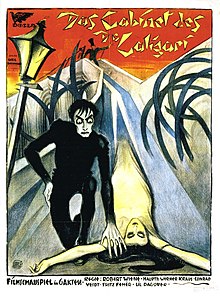
The Cabinet of Dr. Caligari. (Robert Wiene, 1920)
Retrieved from http://en.wikipedia.org/wiki/The_Cabinet_of_Dr._Caligari
Retrieved from http://en.wikipedia.org/wiki/The_Cabinet_of_Dr._Caligari
Traits in an Expressionist film are much focused on the mise-en-scene. The actors’ movements must blend in well with the settings. “Thus, not only did the setting function as almost a living component of the action, but the actor’s body become a visual element.” ( Thompson & Bordwell, 2010 ). The actors move in a jerky or sinuous way. Exaggeration and distortion are not exception. Not only the setting has to be incongruous, the actors had to behave in an unnatural way and overdo their gestures. Another major trait is the juxtaposition of similar shapes within a composition. Editing is simple and more to a slower pace. The camera mostly remained at eye-level angle or chest-level. Expressionist was mostly involved in horror or fantasy films. Other hallmarks of Expressionist are oblique camera angles, distorted angles, high contrast lighting between light and dark to create dramatic shadows, actors’ make-up and clothing. (Benyahia, Gaffney and White, 2006) There are some popular film-makers in this movement, such as Robert Wiene, Fritz Lang, and F.W. Murnau. Nosferatu (1922), The Golem(1920), Metropolis(1927) are examples of Expressionist films.
 |
| Expressionist Filmmakers : Robert Wiene, Fritz Lang, F.W. Murnau ( from left to right ) Retrieved from en.wikipedia.org |
 | |||
| Expressionist Films : Nosferatu
(1922), The Golem(1920), Metropolis(1927) (from left to right) Retrieved from en.wikipedia.org. |
APA References :
Benyahia,
S. C., Gaffney, F., & White, J. (2006) A2 Film Studies:
The Essential
Introduction. United Kingdom : Routledge Taylor & Francis Group.
Mast, G., & Kawin, B.F. (2008). A Short History of The Movies (10th ed.). United
Introduction. United Kingdom : Routledge Taylor & Francis Group.
Mast, G., & Kawin, B.F. (2008). A Short History of The Movies (10th ed.). United
States: Pearson Longman.
Norris, G. (1996). The artistic imagination suppressed. Retrieved from
http://www.vccaedu.org/inquiry/vcca-journal/norris2.html
Thompson, K. & Bordwell, D. (2010). Film History: An Introduction (3rd ed.). New
York, NY: McGraw Hill.
Thompson, K. & Bordwell, D. (2010). Film History: An Introduction (3rd ed.). New
York, NY: McGraw Hill.

No comments:
Post a Comment